Serving Size vs Portion Size: Reading a Nutrition Label Clearly
A label’s serving size is a reference amount; a portion is what you choose to eat. Learn how to scale nutrients, compare packages fairly and interpret US Nutrition Facts labels.
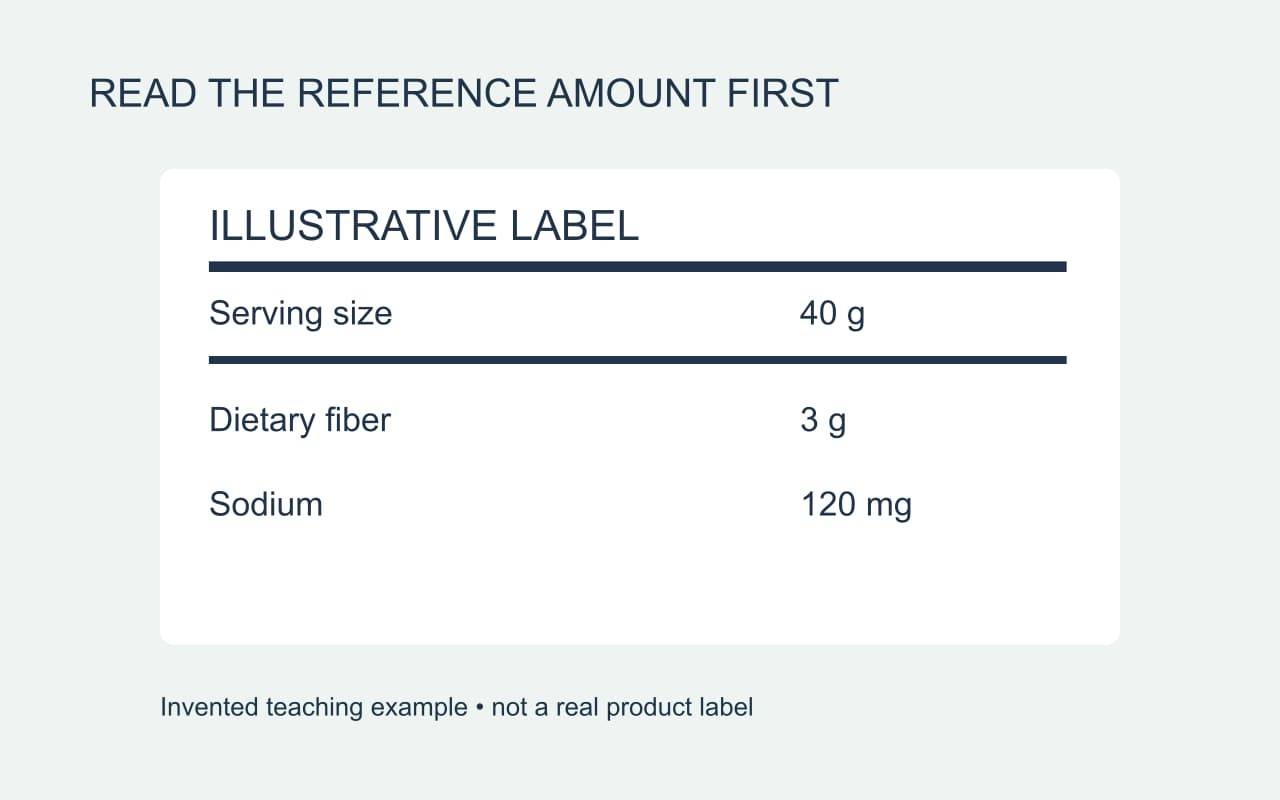
A serving size and a portion size can describe the same amount of food, but they do not have to. The serving size is the reference used on a label. The portion is the amount you actually eat or serve. Keeping those ideas separate makes nutrition information easier to use and prevents a common mistake: treating the label's reference as a personalized instruction about how much you should eat.
Find the reference before reading the numbers
On a US Nutrition Facts label, start with the serving size and the servings per container. The FDA explains that nutrition information is usually listed for one serving, although some packages provide additional information for the whole container. The number beneath calories or a nutrient row has meaning only when you know the amount it describes.
Check both the household measure and the weight or volume shown. A cup, piece or spoonful can be useful in practice, while grams or milliliters help clarify the quantity. Do not assume that two packages using similar-looking panels have chosen identical reference amounts.
A serving size is not an individual recommendation
The FDA states that serving sizes are based on amounts people typically consume, rather than the amount a particular person should consume. That distinction removes unnecessary moral meaning from the number. Eating an amount different from one labeled serving is not, by itself, a complete assessment of someone's diet.
Appropriate portions depend on the person, the meal and other circumstances. If you need individualized advice for a medical condition or another specific goal, a qualified professional can help. The label provides information for a decision; it cannot know the full context of the person holding the package.
Scale the information to the amount used
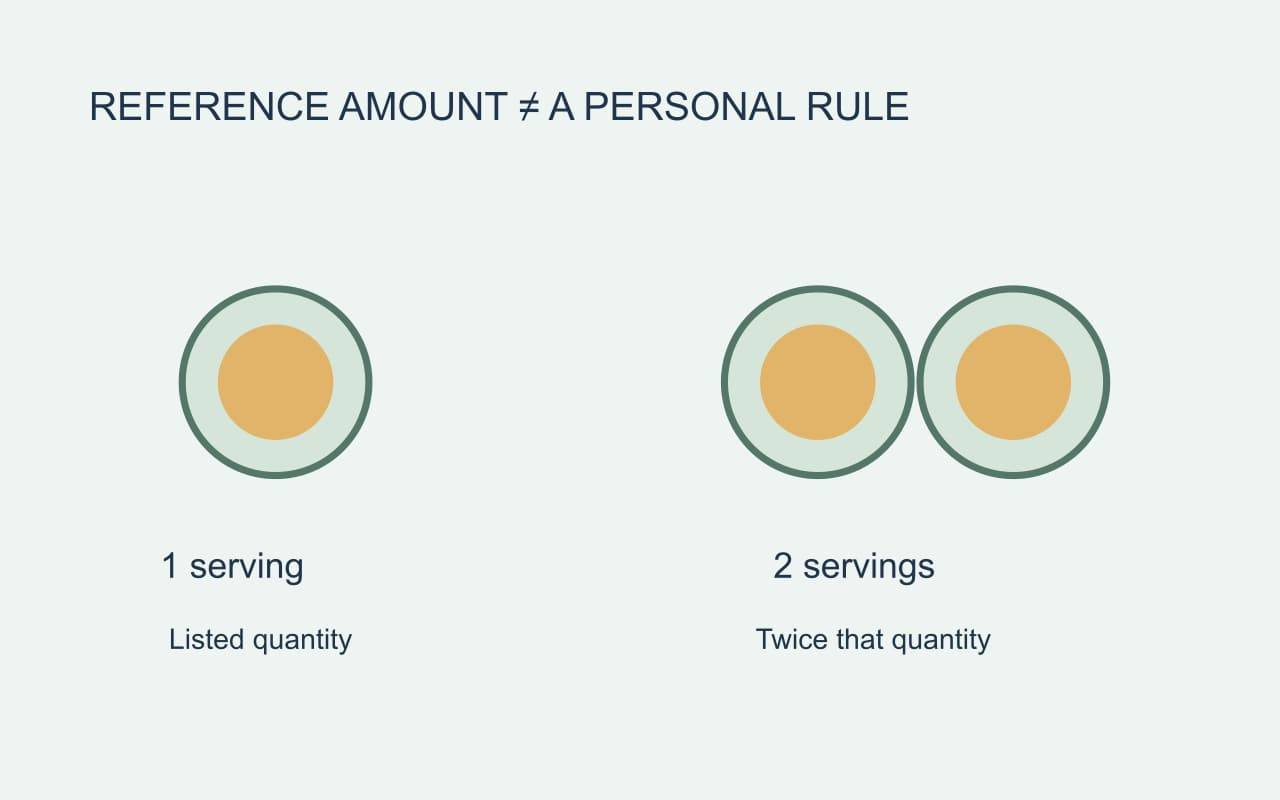
If the portion is twice the labeled serving, the listed nutrient amounts are generally doubled for that portion. If it is half a serving, the corresponding amounts are generally halved. This is arithmetic about the quantity consumed, not a judgment about whether the portion was right or wrong.
Here is an invented example used only to demonstrate the calculation:
| Amount | Fiber if one serving lists 3 g | Sodium if one serving lists 120 mg |
|---|---|---|
| Half a serving | 1.5 g | 60 mg |
| One serving | 3 g | 120 mg |
| Two servings | 6 g | 240 mg |
These figures do not describe a particular product. Use the actual package when making a real comparison, and allow for the rounding used on nutrition labels rather than expecting laboratory precision from a simple calculation.
Check whether the package has two columns
Some containers have a dual-column label, with one column for a serving and another for the package. Read the headings carefully. A small package may contain more than one labeled serving, while another may present its information for the full container. The visual size of the package is not a reliable substitute for reading that detail.
This is particularly useful for drinks and foods likely to be consumed directly from the container. The purpose is clarity about the amount, not a requirement to stop at a particular point. Once you know which column applies, the rest of the panel becomes easier to interpret.
Make comparisons on a common basis
Two foods can appear different simply because one label describes a larger serving. Compare equivalent amounts where appropriate, while also considering the amount you realistically use. A fair comparison might use the same weight, the same volume or the actual role each product plays in the meal.
Do not reduce the decision to one nutrient without considering why you are comparing the foods. The relevant question may concern dietary fiber, an ingredient restriction, convenience or something else. Our fiber guide shows how the serving reference connects to one useful row without claiming that row explains the entire food.
Measure once if the reference is hard to picture
If you cannot visualize a label's amount, using an appropriate measuring tool once can help. You might discover that your usual bowl holds more or less than the printed reference. That information can make the label easier to use without requiring every meal to become a detailed weighing exercise.
Choose the level of precision that serves the purpose. A clinician-directed plan may require particular measurements, while an ordinary comparison may need only a clearer understanding of the reference. If tracking becomes distressing or overly rigid, seek support rather than assuming more measurement must be better.
Keep the meal in view
A packaged ingredient is often one part of a larger meal. The label describes that product, not the vegetables, sauce or other foods added around it. Likewise, a portion served at a restaurant may not match a reference on a supermarket package. Use information that applies to the actual food and amount where available.
A useful habit is to ask three questions: what amount does the label describe, what amount am I using and what information matters for this decision? Those questions are usually more helpful than trying to memorize a universal serving for every possible food.
Serving size makes the label interpretable; portion size connects it to the plate. Once those roles are clear, the calculations and comparisons become straightforward. The label becomes a practical information source rather than a set of instructions pretending to know every person's needs.